Pages

Showing posts with label Dinners. Show all posts

14 January 2018

Hungarian Goulash

[In a really bad Russian accent] Here comrade, put some hairs on your chest with some good old eastern European food. Just like babushka used to make.*

Seriously though, if you ever struggled to grasp the meaning of the word moreish, make yourself a pot of this and thank me later.


*I only say this to annoy my Hungarian friends.

Ingredients:
  • Oil/butter for frying
  • 600g of diced beef (or a mixture of beef and pork)
  • 2 medium onions, chopped
  • 1 tbsp of paprika
  • 1 tsp of spicy paprika
  • 1 tsp of ground caraway
  • Salt and pepper, about a teaspoon of each
  • 1 bay leaf
  • 3 cloves of garlic, crushed
  • 1 tbsp of tomato paste
  • 1 carrot
  • A handful of fresh parsley
  • 3 medium potatoes, peeled and diced
  • 1 green bell pepper, diced
  • Water
  1. Fry off the beef on a bit of oil or butter (or a mixture of both) in a pan, until it’s browned. Make sure not to overcrowd the pan – you may need to do it in batches. Once done, transfer to a large soup pot.
  2. In the same pan (you may need to add some more oil), gloss the onions and transfer them to the soup pot together with the meat.
  3. Add paprika, caraway, salt and pepper, and bay leaf. Fry together on low heat for a couple of minutes, stirring constantly to make sure the spices don’t burn.
  4. Add just enough water to cover all the ingredients in the pot, cover and simmer for about an hour – or until the meat is tender.
  5. Add tomato paste, garlic, parsley, carrots, potatoes and peppers, and again enough water to cover everything. Bring back to boil, and simmer until potatoes are cooked.
  6. Taste and add more spices if necessary.

Moroccan Harira


A very aromatic, flavourful, hearty soup. One of my personal favourites. Make sure you get good quality lamb and you'll fall in love with this dish.


  • Oil/butter, for frying
  • 500g of diced lamb
  • 1 chopped onion
  • 3 tbsp of fresh coriander, plus extra for garnish
  • 3 tbsp of fresh parsley
  • 1/2 tsp of ground ginger
  • 1/2 tsp of ground turmeric
  • 1 tsp of ground cinnamon
  • Salt and pepper (to taste)
  • 400g can of chopped tomatoes
  • 75g of green lentils
  • 400g (240g drained) can of chickpeas, drained and rinsed
  • 75g of vermicelli
  • 2 egg yolks
  • Juice of ½ lemon

1. Fry off the lamb on a bit of oil or butter (or a mixture of both) in a pan, until it’s browned. Make sure not to overcrowd the pan – you may need to do it in batches. Once done, transfer to a large soup pot.
2. In the same pan (you may need to add some more oil), gloss the onions and transfer them to the soup pot together with the meat.
3. Add coriander, parsley and the spices. Mix and fry for a couple of minutes on low heat, stirring constantly to make sure the spices don’t burn.

4. Add the tomatoes, mix and cook together for about 5 minutes.
5. Add enough water to cover everything and simmer for about an hour.
6. Add more water again (about 1l), and add the lentils. Cook for further 30 min.
7. Add the chickpeas and cook until they’re soft (15-20ish minutes).
8. Add the vermicelli. Cook for 5 minutes (or however long it tells you to cook them on the packet). 9. If the soup is too thick at this point, add more water again.
10. Whisk the egg yolks and about half of the lemon juice together. Pour into the soup as it’s simmering, mixing constantly, and immediately take off the heat. Mix through until the yolk is fully incorporated into the soup.
11. Taste it and season/add the rest of the lemon juice if necessary.
12. Serve with a sprinkling of fresh coriander.


It's like Mac 'n Cheese, only with flavour.


A much, much better version of the old time classic (she said, humbly). The flavours are subtle but work perfectly to add a bit of character to the dish.


  • 3 Tbsp of slightly salted butter
  • 1 onion, chopped
  • 1 red chilli, chopped
  • 1 garlic clove, crushed
  • A small bunch of chopped fresh coriander
  • 1 bay leaf
  • 1/2 tsp of ground allspice
  • 1/2tsp of ground cinnamon
  • 3 Tbsp of plain flour
  • 500ml of whole milk
  • 250g of grated mature cheddar
  • salt and pepper, to taste
  • macaroni
  • 1 tbsp of chopped fresh mint


  1. Gloss the onion on the butter
  2. Add the coriander, garlic, chilli, bay leaf and spices. Fry on low heat for a couple of minutes, stirring constantly.
  3. Add the flour and mix in.
  4. Add the milk, little by little, mixing it in as you go. Once you've added all the milk in, simmer it for another 5 min or so, stirring constantly, until the sauce thickens.
  5. Add in the cheese and mix in until it's dissolved. Taste and season with salt and pepper if necessary.
  6. Add in the mint and stir in.
  7. Boil the macaroni in a pot of salted water as per the instructions on the package.
  8. Add the cooked macaroni into the cheese sauce and mix in until it's evenly coated.


17 September 2017

Hungarian potato pancakes


They're not actually Hungarian, they're Polish. We just call them 'Hungarian' to make them sound fancy and foreign.


Ingredients:

For the stew

  • 500g of diced pork
  • 500g of diced beef
  • 1 large or 2 small onions, diced
  • 1 tbsp of salted butter
  • 2 red peppers, roughly chopped
  • 3 cloves of garlic
  • 1 tsp of ground caraway
  • 1 tbsp of spicy paprika
  • 1 tbsp of smoky paprika
  • 1 tbsp of chilli flakes (optional)
  • 2 tbsp of sour cream
  • 1 tbsp of plain flour
  • salt, to taste
  • 1 cup of water
  • a dollop of sour cream to serve
  • oil for frying


For the potato pancakes

  • 500g of potatoes, peeled and finely grated
  • 1/2 a large onion, or 1 small, grated (I strongly recommend using a food processor for that)
  • 1 egg
  • 2 tbsp of plain flour
  • 1/2 tsp of salt
  • a pinch of pepper
  • sunflower oil (plenty of) for frying


1. Heat up oil in 2 pans. Add butter to one of them, and once the butter melts add in onions. Fry until the onions are lightly browned. Brown the meat in the other one, in batches, so that the pan isn't overcrowded.
2. Put the meat, onions, garlic, water, smoked and spicy paprika, caraway and a good pinch of salt in a slow cooker. cook on low heat for about 5 hours. If you don't have a slow cooker, just use a pot and slow cook it the old-fashioned, analogue way. Light a bonfire in your kitchen and hang a cauldron over it or something, dunno.
3. Once the meat is completely tender, taste the stew and spice up/season as required.
4. Mix the cream and flour in a cup, and add a few spoonfuls of the liquid from the stew, one by one, mixing it in so that there are no lumps. Now add it back into the stew and mix in. Cook for another 5 min or so.
5. For the potato pancakes, mix the grated potatoes and onions, egg, flour and seasoning together. If you feel adventurous, you can add chilli flakes to it as well.


6. Fry on a generous amount of oil and medium heat, like you would normal pancakes, until golden brown and cooked all the way through. It may take about 10 min on each side.


7. Serve the pancakes with the stew and a dollop of sour cream. Also goes well with pickled gherkins or peppers.


Kefir dumplings


To be served with a stew of your choosing.

Making a stew, not sure what to serve it with? Boom. Kefir dough dumplings. You're welcome.


Ingredients:

  • 500g of Kefir (you'll need to venture into the chilled Polish isle in your local supermarket for that one. Don't worry, just act normal. Don't run. With any luck you won't run into your cleaner.)
  • 5 tbsp of sunflower oil
  • 1 tbsp of white wine vinegar
  • 1 tbsp of granulated sugar
  • 1 tsp of salt
  • 700g of plain flour, plus a bit more for dusting
  • 1 tsp of bicarbonate soda


  1. Mix the Kefir, 1 tbsp of oil, vinegar, sugar and salt in a bowl.
  2. Sift the flour and bicarbonate soda into the same bowl and mix in.
  3. Transfer onto a work surface dusted with flour and knead until the dough stops sticking to your hands. You may need to work more flour into it. The dough should be quite soft.
  4. Divide in into 4 equal parts.
  5. Flour the worktop again and roll each part into a very thin rectangle (no more than 0.5cm).
  6. Pour 1 tbsp of oil on top of it and smear around with your fingers until it's evenly covered.
  7. Roll up the dough from one side, like you would a cinnamon swirl, until you get a long sausage shape.
  8. Cut into roughly 1 inch chunks.
  9. Repeat with the remaining 3 parts. You should get roughly 30-35 dumplings.
  10. When your stew is ready and boiling, reduce the heat and gently place all of the dumplings on top of it. You may want to do this in a fairly deep dish, because you'll have to cover it. My dumplings were sticking out a bit, so I couldn't use a normal lid for the pan, but I happened to have a wok of the same size, so I used that as a lid. Also, the next step is to cook them on low-medium heat for about 40 min, so you may want to make sure your stew has plenty of liquid in it. Otherwise it may burn a bit.
  11. Cook for about 40 min, covered (told you).


4 July 2016

Texas BBQ Pulled Pork


This recipe is perfection. I love it and want to have its babies. It's so good it makes me want to cry. Happy 4th of Whatever Excuse to Cook This!


Ingredients:
  • 1 teaspoon oil
  • 1.8-2kg pork shoulder
  • 1 cup bbq sauce
  • 1/2 cup apple cider vinegar
  • 1/2 cup chicken broth
  • 1/4 cup light brown sugar
  • 1 tbsp prepared yellow mustard
  • 1 tbsp Lea & Perrins sauce 
  • 1 tbsp chili powder
  • 1 large onion, chopped
  • 3 large cloves garlic, crushed
  • 1 1/2 tspdried thyme
  • burger buns
  • butter
  1. Chuck everything but the last 2 ingredients into a slowcooker.
  2. Cook on low heat for 10-12 hours.
  3. shred up the pork with whatever utensils you like.
  4. Toast the rolls, butter them (don't hold back on the butter), gently place the pork on the rolls and marvel over the beauty of your creation until you cry.


Pierogi - 'ruskie' and with meat


Pierogi are probably the most popular dish from the entire Polish cuisine. And rightly so - I've never met anyone who doesn't like them. They can be stuffed with literally anything. They are just as popular in a savoury variation as they are in sweet, stuffed with things like fruit and mascarpone, or poppy seeds and honey. Here you'll find recipes for the two most common (savoury) types. Pierogi 'ruskie' are stuffed with curd cheese, potatoes and onion. Pierogi with meat are stuffed with your neighbour Irek who has been playing Polish hip hop too loud after 10pm.


Pierogi Ruskie Stuffing:

  • 1kg of waxy potatoes, peeled and roughly chopped
  • 1kg of Twarog – Polish curd cheese (either full- of half-fat)
  • 1 large or 2 small onions, finely chopped
  • 3 bay leaves
  • 5ish allspice berries
  • 2tbsp of butter
  • Salt, pepper and Vegeta spice, to taste
  1. Boil the potatoes in salty water until they’re soft. Drain them, return back to the pot and put back on the heat for a minute, tossing them constantly, to evaporate any excess water. Let them cool down a little bit until they’re warm to touch.
  2. Break up the curd cheese into small bits with your hands or with a fork and add to the potatoes. Mash the cheese and the potatoes together. It may be a bit tough to mash it, but make sure it’s quite smooth and evenly combined. Do not use a mincer or a food processor, as this will overwork the mixture and make it too runny.
  3. Melt the butter in a pan. Add the onion, bay leaves and allspice berries. Fry on very low heat until the onions are completely soft and glossy, and infused with the spices.
  4. Transfer the onion and spices into the potato and cheese mix. You can add some of the butter as well, but stop if it starts getting too runny. It should have the texture of raw shortcrust pastry. Mix everything together, but be careful not to break up the bay leaves too much, as we’ll have to fish them out later.
  5. Season to taste with salt, pepper and Vegeta. Always add Vegeta before salt, as it’s quite salty itself.
  6. The mixture is ready to use, but if you have time, you can leave in the fridge to marinate for a couple of hours or overnight.
  7. Before stuffing the pierogi, make sure you remove all the bay leaves and allspice berries from the stuffing.


Meat Pierogi Stuffing:

  • 1 whole chicken
  • 4 beef ribs or other equivalent of beef on the bone
  • 3 small or 2 large carrots
  • 2 small or 1 large parsnip
  • 1 leek
  • 3 bay leaves
  • 5 allspice berries
  • 3 stock cubes (a combination of poultry and beef would be the best)
  • 1 large or 2 small onions, chopped
  • 2 tbsp of butter
  • 1 egg
  • Salt, pepper and Vegeta spice, to taste
  1. Place the meat, vegetables, stock cubes, bay leaves and allspice berries in a large soup pot. Make sure it’s big enough to fit all of it comfortably – if not, split it between two pots or halve the ingredients. Fill the pot with enough water to cover all the meat and place over a low heat. Keep it simmering very slowly for at least a couple of hours, or until the meat is really tender and starts falling off the bone.
  2. Remove the vegetables from the pot and place in a large bowl.
  3. Take the meat out as well, and let it cool a bit until it’s safe to touch. Strip all the meat off the bones, including all the fat (but not the chicken skin), and add to the bowl with the vegetables.
  4. Melt the butter in a pan and add the onion. Fry on low heat until the onion is completely soft and glossy. Add the onion and the butter from the pan into the meat and vegetables.
  5. Mince the meat, vegetable and onion together in a meat mincer on the most coarse setting. Do not over-mince it as you’ll get pâté.
  6. Season to taste with salt, pepper and Vegeta. Again, always add Vegeta before salt, as it’s quite salty itself.
  7. Separate the egg white from the yolk. Add the yolk to the meat and mix through. Beat the white until you get hard peaks, and then gently fold in to the meat as well, until it’s evenly combined.
  8. The meat stuffing doesn’t have a very long shelf life, so you should use it up to make the pierogi the same day, ideally.
NB: The remaining stock from this part of the recipe can be easily used to make most soups, stews and sauces. It's also freezable.


Pierogi dough and assembly:

  • 1kg of Poznanska flour (best type is from Lubella)
  • 2 tbsp of sunflower oil
  • 1 tsp of salt
  • 2 glasses of boiling water
  1. Sieve half of the flour into a large bowl. Add salt and oil.
  2. Pour the water into the flour, one tablespoon at a time, mixing it in with a spoon.
  3. Once all the water is in, start kneading the dough with your hands. If it’s too hot to touch, add a bit more flour first.
  4. Start adding the rest of the flour, bit by bit, as you’re kneading the dough. Once it’s no longer sticking to the bowl, take it out onto a flat surface dusted with flour and continue kneading.
  5. The ideal texture is when you stick a finger in the dough and when you take it out it slowly goes back to original shape – so a bit rubbery. You may not need to use up all the flour to achieve that. If you add too much flour, just add a bit more hot water.
  6. Put the ready dough back into the bowl and cover with a tea towel. Leave for at least 10-20 minutes to rest.
  7. Take half of the dough at a time and roll it out so that it’s about 2mm thick.
  8. Using a glass or a cookie cutter, cut out circles about 7cm in diameter.
  9. Place a bit of filling in the centre of the circle, fold it in half, and squeeze the edges with your fingers to seal them and create a little parcel.


NB: For the amount of stuffing I made (both above recipes combined) I needed dough from about 2.5kg of flour.


Boiling/Storing/Freezing:
  1. Bring a large pot of water to a boil with 1 tbsp of salt and 2 tbsp of sunflower or vegetable oil.
  2. Add no more than 15 pierogi at a time. Gently stir them from time to time so that they don’t stick together.
  3. For serving immediately, wait until the pierogi start floating, and then boil them for another 3-4 minutes. Remove them from the pot with a slotted spoon and place on a large serving plate with a tbsp of butter.
  4. For freezing, boil them until they start floating and remove them immediately with a slotted spoon. Take them out onto a large plate and allow to cool, making sure you don’t pile them up on top of each other and that they don’t touch too much, because they will stick together. Once they’re cool, lay them out on a chopping board so that they don’t touch and place it in the freezer. Once they’re completely frozen, you can transfer them into a freezer bag. To cook them again, place the frozen pierogi (only about 5 at a time) into boiling water with salt and oil, wait until they start floating and cook for another 3-4 minutes. Remove them from the pot with a slotted spoon and place on a large serving plate with a tbsp of butter.


Serve with melted butter, fried chopped onions and fried cubetti di pancetta.


I like to serve Pierogi Rusie with a dollop of sour cream, and Meat Pierogi with a sour cabbage salad.


25 November 2014

Russian chicken and mushroom pie


A chicken and mushroom pie with the addition of sour cream and fresh dill. Much better than the British equivalent, in my opinion. It still has the same, lovely, creamy taste, but with added kick and character. Bon appetit!


Ingredients:
  • 125g long grain rice
  • 50g butter
  • 300g mushrooms, quartered or roughly chopped
  • 1 onion, finely chopped
  • 2 garlic cloves, finely chopped
  • 2 tbsp plain flour
  • 300ml milk
  • 500g chicken breasts or thighs, chopped into chunks
  • juice of ½ lemon
  • 150ml of soured cream
  • a bunch of fresh dill, finely chopped
  • 250g pack ready puff pastry
  • 1 egg beaten with a splash of milk, to glaze

  1. Boil the rice until it's al dente – about 10 mins.
  2. Melt the butter in a large frying pan. Fry the chicken, mushrooms and onion until the meat is browned and the onions are glossy. 
  3. Add the garlic and stir in the flour. Cook for 1-2 mins. 
  4. Now take the pan off the heat and gradually add the milk, stirring constantly. Put the pan back on the heat and bring to the boil, stirring all the time until the sauce thickens. 
  5. Season to taste with salt and pepper. Stir in the lemon juice, soured cream and dill.
  6. Spread the rice in the bottom of a pie dish, then spoon the meat and sauce on top. 
  7. Roll out the pastry to the size of your pie dish and cover the pie. Make several incisions for the hot air to escape. Glaze the top of the pastry with the egg wash.
  8. Heat oven to 180C (fan). Bake for about 30 mins, or until the pastry is golden.
The pie is freezable, so you can split it into portions and store in the freezer until needed for a cheeky quick lunch or dinner.


21 October 2013

Blue Cheese Pappardelle


Ingredients:

  • 2 small or 1 large courgette
  • 5 chestnut mushrooms, finely sliced
  • 150ml of double cream
  • 1 large or 2 small onions, chopped
  • 2 tbsp of olive oil
  • 3-5 cloves of garlic (crushed, to taste)
  • 150g of blue cheese, crumbled
  • freshly ground black pepper
  • small pinch of salt
  • 3 chicken breasts, diced
  • Pappardelle or Tagliatelle pasta - enough for 3-4 portions


  1. In a large pan or wok, gloss the onion, add chicken and brown it. Add the mushrooms, salt and pepper and fry until the mushrooms soften up a bit.
  2. Wash the courgettes. Using a potato peeler, slice them into thin, long ribbons.
  3. Add the courgettes to the pan and toss everything together. Fry until the courgettes are soft.
  4. Cook the pasta according to instructions and drain it.
  5. In a milk-pan, slowly bring the cream to boil. Add in the cheese and mix constantly until all the cheese is dissolved.
  6. Add the pasta to the wok and pour the cheese sauce evenly over it. Mix everything together. Season to taste with more pepper if needed. Add the garlic, mix it in and serve.

30 September 2013

Sour Cucumber Soup


One of the favourite Polish classics, done in a very traditional way. The stock is based on pork ribs, which give it a wonderfully sweet, aromatic flavour, much more hearty than chicken or vegetables. The meat is juicy and melt-in-your-mouth tender, and together with the sweet carrots and dill mellows down the sourness of the cucumbers a little bit, adding up to a flavourful, moreish combination.


Ingredients:
  • About 900g of pork ribs
  • 1 jar (should be about 0.9-1l) of sour cucumbers, or cucumbers in brine – easily available from any Polish section in any major supermarket.
  • 2 large carrots, grated
  • 1-2 parsnips, chopped into pieces, sliced up or however else you like it.
  • 1 onion, finely chopped
  • 4-5 allspice berries (or a tsp of ground allspice)
  • 3-4 bay leaves
  • 1 tbsp of ground black pepper (or less or more, depending on your taste)
  • 1-2 stock cubes (vegetable, pork, bacon or chicken will do)
  • A small bunch of finely chopped fresh dill (about 2 tbsp)
  • 500g of potatoes, peeled and chopped into bite-size pieces
  • 2 tbsp of butter

  1. Place the pork ribs in a large soup pot with about 2 litres of cold water, add the bay leaves, allspice, pepper, grated carrots, chopped parsnip and 1 stock cube. Place on very low heat and slowly bring to boil. Make sure it doesn't boil too hard – you just want it to simmer away very gently. Leave it like this covered on very low heat for about 2-3 hours, or until the meat is so soft it falls off the bone as soon as you touch it. By then you should have quite a lovely, aromatic stock.
  2. Fish the ribs out of the stock and place them on a plate or in a bowl. Let them cool until they are safe to touch and peel the meat off the bones. Dispose of the bones, chop up the meat into small bits and put the meat back in your soup.
  3. Take the sour cucumbers out of the jar (keep the water) and grate them. In a pan, melt the butter and roughly gloss the onion in it. Add in the grated cucumbers and fry them up a little bit until they become a bit softer and soak up the butter.
  4. Add fresh dill, and the cucumbers with onion to your soup. At the same time, pour in about half of the cucumber brine water you had left over. Bring the soup back to boil and let it simmer for about 20 minutes. After about 20 minutes taste the soup and decide whether it needs any more spices – if you'd like it a bit more sour, add the rest of the cucumber brine water. If it needs more salt, add another stock cube. If you want it to have a bit more heat, add some black pepper. If you decide to add some more cucumber brine, leave it simmering again for a while before you try it again, as it will gradually become more and more sour over the next few minutes.
  5. In a separate pot, parboil your potatoes in salty water. Once they are ready, drain them and add to your soup.
  6. Simmer it all together a little longer until the potatoes are fully cooked.
  7. Plate up and garnish with a bit of fresh dill. If you want the soup to be a bit more creamy, you could add a spoon of sour cream to your plate. My other half even likes to add a splash of Tabasco!

26 August 2013

Pigeons


No, they are not actual pigeons :) Gołąbki, or "pigeons" in English, are a very traditional Polish dish, which consists of cabbage leaves (I bet you didn't see that one coming) stuffed with rice, mince, mushrooms and herbs and spices. They can be served with a lovely, zesty tomato sauce or a wild forest mushroom sauce - both options are amazingly delicious and ridiculously easy to make.


Ingredients
  • 500g of beef or beef/pork mince
  • 250g of rice (500g boiled)
  • 2 large onions, chopped
  • 5 white mushrooms, chopped
  • A small bunch of fresh parsley, chopped
  • 2 medium or one large white cabbage
  • 1 glass of stock (can be beef, chicken or vegetable)
  • Salt and pepper (you can substitute salt with Vegeta, if you have any)
  • Oil for frying

  1. First of all, you’ll need to prepare the cabbage leaves. A fresh white cabbage is quite tough and if you tried to separate the leaves they would break, so what you need to do is cut out the core of the cabbage with a sharp knife (without slicing the cabbage itself), then place it in a large pot of water (so that it’s fully covered) and boil it until the leaves become soft and start peeling off. You may find that a couple of layers of leaves will come off and the ones underneath are still tough – in that case just take the soft ones off and put the rest of the cabbage back into the boiling water. Repeat until you get through to the really small leaves, which will be of no use. You’re only interested in ones that are large enough to wrap them into a parcel (so probably no smaller than ca. 15cm in diameter). Be careful not to burn yourself when peeling the leaves off!
  2. Once you’ve got all of your leaves separated, you’ll need to trim the big thick vein in the middle of each leaf. All you need to do is to take a knife and scrape off the large bulge in the middle of the leaf, so that it’s the same thickness as the rest of the leaf. This way it will be easier to fold the leaf.
  3. Now on to the stuffing: Gloss the onions with the mushrooms in a frying pan with a bit of oil. Add the mince and brown it.
  4. Boil the rice according to instructions in salty water.
  5. Mix the rice with the mince and fresh parsley. Season the mixture to taste with salt (or vegeta) and pepper. You can actually taste it, because all the ingredients should be thoroughly cooked, so it’s safe to eat.
  6. Wrap the stuffing in the cabbage leaf (a bit like a burrito) and pile the parcels up in an oven-proof dish. Pour some stock over the parcels and cover the dish with a lid.
  7. Place the parcels in an oven and cook at 180 degrees for about 30 minutes.


Tomato Sauce:

Ingredients
  • 3 tbsp of flour
  • 3 tbsp of unsalted or slightly salted butter
  • 1l of stock (vegetable or pork would be best)
  • 5 tbsp of tomato puree
  • Salt and pepper

  1. Prepare the roux by melting the butter in a pan and mixing in the flour. Fry until golden brown.
  2. Transfer the roux into a saucepan and add in the stock. Mix until you get a nice, thick sauce base.
  3. Mix in the tomato puree. Season to taste with salt and pepper if needed.


Mushroom Sauce:

Ingredients
  • 3 tbsp of flour
  • 3 tbsp of unsalted or slightly salted butter
  • 0.5l of stock (vegetable or pork would be best)
  • A pack of dried wild forest mushrooms
  • Salt and pepper

  1. Place the mushrooms in a pot with about 0.5l of hot water and leave it overnight to let the mushrooms plump up and give off some of their flavours. By the next day the water should be dark brown.
  2. Bring the water and the mushrooms to boil and simmer for about 20 minutes. Fish the mushrooms out (keep the water) and let them cool. Then chop them up very finely and return them back to the water.
  3. Prepare the roux by melting the butter in a pan and mixing in the flour. Fry until golden brown.
  4. Transfer the roux into a saucepan and add in the stock. Mix until you get a nice, thick sauce base.
  5. Mix in the mushrooms with the mushroom-infused water. Mix until you get a nice, uniform mushroom sauce. Season to taste with salt and pepper if needed.


Serve the “pigeons” with either sauce. Both the “pigeons” and the sauces are also perfectly freezable, so if you end up cooking a huge batch, just split up some portions into Tupperware boxes and chuck them in the freezer for later.


19 August 2013

Haggis, Potato and Apple Tart


The tart is really lovely on its own and it's possibly the first recipe I ever used that I thought didn't need adjusting or changing any proportions at all. The only addition I made was a little bit of tangy gravy sauce to make it a bit more moist. It will go really well with some greens as well, like broccoli.


I found this recipe in a cook book I picked up for £2 in a charity shop – by far the best cook book I've ever had, if you can get your hands on it get it now.


Ingredients:
  • 450g of potatoes, peeled and thinly sliced
  • 2 garlic cloves, crushed
  • 1 tbsp of salt
  • about 1/2 of freshly ground nutmeg
  • 1 tsp of ground black pepper
  • 400g of ready-made puff pastry
  • 300g of haggis
  • 2 cooking apples - peeled, cored and sliced
  • egg wash (1 egg and a splash of milk, beaten together with a fork)


 1. You will need a rather large tart dish - mine was a bit too small (23cm diameter, 4cm deep), which meant I had leftovers, which meant I had to make an apple strudel... Ah well. ;)
2. Roll out the puff pastry. You will need two discs - one about 25 cm in diameter and one slightly larger. Line the dish with the larger disc. Trim away any uneven edges, but leave a bit of a rim, so that you can fold it in later.
 3. Mix the potatoes with garlic, nutmeg, salt and pepper. Layer half of the potatoes on the bottom of the dish (sorry, forgot to photograph that stage).

Then take the haggis out of its packaging. It will have the texture of sticky play-dough. Roll it out with a rolling pin until it matches the size of your dish and place it on top of the potatoes.
 4. Layer the apples on top of the haggis.
 5. As a final layer, place the remaining half of the potatoes on top of the apples...
6. ...and finally cover the whole tart with the other disc of pastry. Fold the edges together using some egg wash as glue and make a few small cuts in the surface of the pastry to let the steam escape. Brush the whole surface thinly with egg wash.

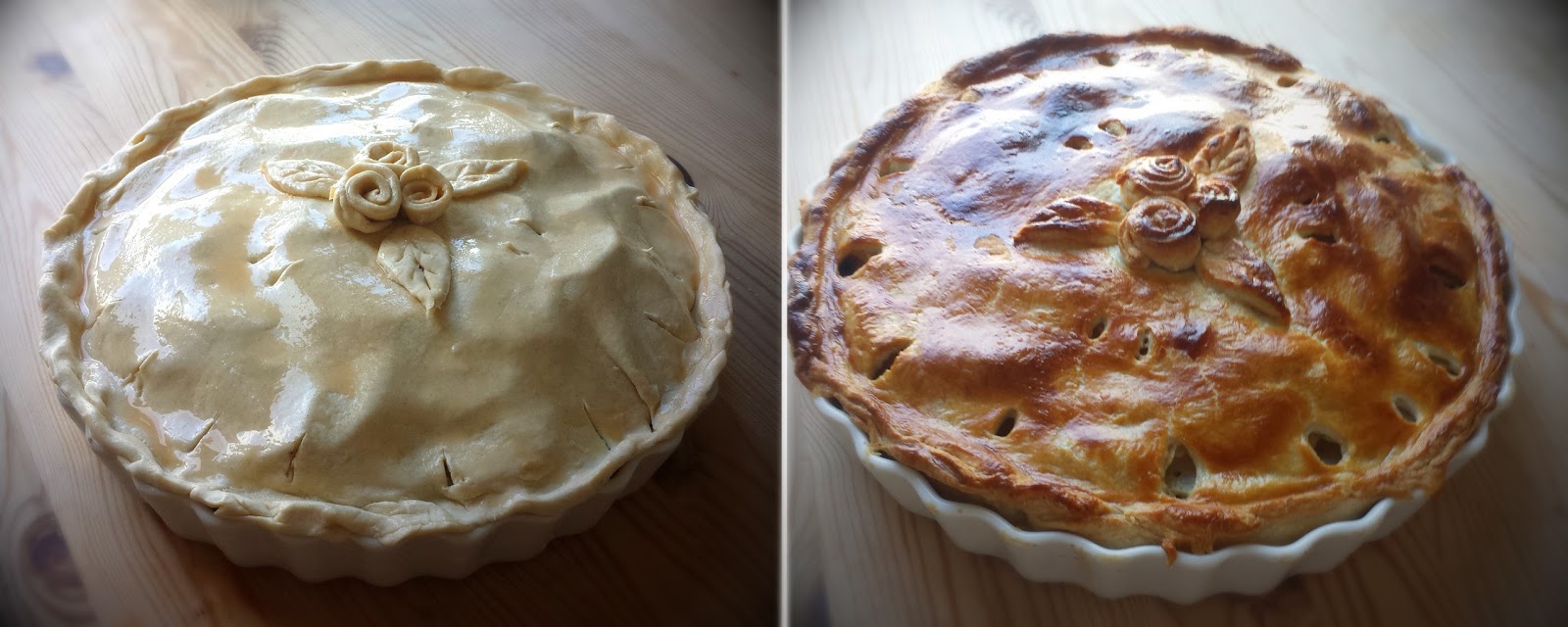
I also used some pastry off-cuts to make flowers and leaves.
7. Place in an oven pre-heated to 200 degrees and bake for about 40 minutes.

As you can see, my oven insists on burning one side of everything. I think that damn thing hates me.


For the sauce

I cheated here a little bit. I only needed a little bit of sauce, so rather than cooking beef stock from scratch I used gravy granules to make about a cup of beef gravy, and then spiced it up with a good splash of Lea and Perrins Sauce and about a teaspoon of finely ground black pepper. The sourness of Lea and Perrins corresponds really well with the apples, and the pepper matched the spiciness of haggis.


As I said, the tart dish I used was too small, so I ended up with a bit of apples left over. I also bought a big pack of puff pastry, which meant I had that leftover as well. I figured it would have been an absolute abomination not to use it to make a quick and simple apple strudel. :) Have a look here.


5 August 2013

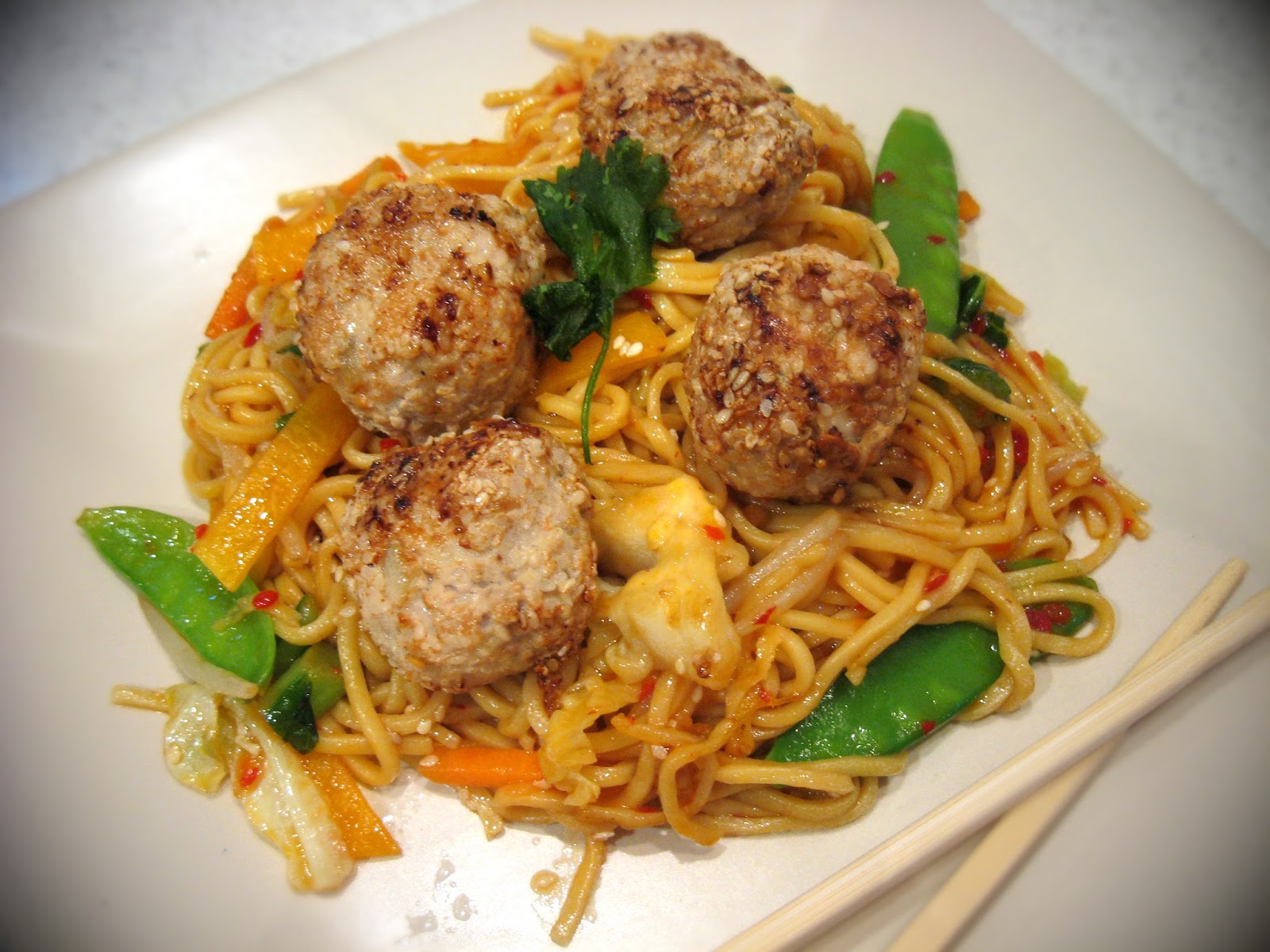
Pork Meatballs with Sesame Seeds and Sweet Chilli Stir-Fry.


This one here is a bit of a cheat recipe to be honest, as it calls for a lot of ready ingredients. But it’s a nice, simple alternative to the usual chicken-and-vegetable stir-fry I tend to make so often out of sheer laziness. And there’s nothing wrong with a bit of a culinary cheat every now and then ;) In fact without them Jamie Oliver would be out of a job tomorrow.


...Ouch.


Ingredients
  • 500g pork mince (I bought pork chops and minced them at home - that way you can be sure of the quality)
  • 3 onions, chopped finely
  • 2 cloves of garlic, chopped
  • 1 egg
  • Dark soy sauce, about 3 tbsp
  • Sesame seeds (about 5-6 tbsp)
  • sunflower oil (for frying)
  • a pack of stir fry vegetable mix of your liking
  • about 300g of egg noodles
  • sweet chilli sauce


  1. Gloss the onions on low heat in a little bit of oil and let them cool down to room temperature. Mix them together with the mince, garlic, egg, 1 tbsp of soy sauce, 1 tbsp of sweet chilli sauce and 1 tbsp of sesame seeds.
  2. Once it's all mixed together quite well, form about 20-ish meatballs. Place the remaining sesame seeds on a plate and roll the meatballs around to coat them.
  3. Fry the meatballs in a pan with a bit of oil on high heat for a couple of minutes just to brown them on the outside, then turn the heat down to medium and fry them for about 15 minutes, turning regularly.
  4. Now onto the rest - you can use the same frying pan, just take the meatballs off it and top up the oil a bit if needed, remembering to keep the meatballs warm. Place the stir fry mix in the pan and add the remaining 2 tbsp of soy sauce, plus a good dollop of the sweet chilli sauce, according to your liking. I added about 100g, give or take. If youe have any leftover sesame seeds, chuck them in there as well. Fry for about 5 minutes or until your stir fry vegetables soften a bit.
  5. Mix in the noodles and fry for another 2-3 minutes. And that's your stir-fry done! All you need to do now is serve it with the meatballs and enjoy! :)


N.B. I found that there were slightly too many meatballs for me, so I simply froze the leftover ones for next time.


15 July 2013

Leek and Potato Soup


One of the simplest recipes I've ever uploaded here, but I couldn't resist it :) There's something nice and homely about the leek and potato soup. I like it chunky and without milk or cream, which makes it even quicker and easier. Enjoy!


Ingredients:
  • 2 large leeks, chopped into small chunks
  • 3 small or 2 large onions, chopped into small chunks
  • 2 carrots, chopped into small chunks
  • 4-5 medium white potatoes, peeled and chopped into chunks
  • 3l of chicken stock
  • 3 tbsp of salted butter
  • 5 allspice berries, or 1 tsb of ground allspice
  • 1 tsp of ground black pepper


  1. Boil potatoes in salty water, drain and set aside.
  2. Melt the butter in a pan, add the onion and leeks and fry on medium heat for 10-20 minutes until the leeks are soft and the onions are glossy.
  3. Place the carrots, leeks and onions in a large pot. Add the stock, allspice and pepper and boil until the carrots are soft.
  4. Add the potatoes and heat up for another minute or two.


1 July 2013

Potato, Onion and Chorizo Frittata


My other half's speciality :) Can't really claim this recipe as my own, but it's so delicious it had to make the blog. I really recommend this one - sounds very simple but is far from it. A very fulfilling, flavourful, interesting meal. 


Ingredients:
  • 4 potatoes, peeled and cut into chunks
  • 6 eggs
  • 120g of chorizo sausage, sliced
  • 1 large onion, very finely sliced
  • juice of 1 lemon
  • Olive oil
  • Salt and pepper
  • A bunch of fresh basil leaves


  1. Preheat an oven to 250C. Boil the potatoes in salty water. Drain them and set them aside.
  2. In an oven-proof pan, fry the chorizo slices until it starts getting crispy.
  3. Beat the eggs with a fork, season with a pinch of salt and pepper and add them to the pan with chorizo. Add in the potatoes as well and heat for about 30 seconds and transfer the whole pan into the oven until the frittata is golden brown on the top and just cooked in the middle.
  4. Mix together the onions, lemon juice, a spoon of olive oil and a small pinch of salt and pepper in a bowl. Leave for a couple of minutes to soften a little bit in the salt.
  5. Serve the frittata with the onions on the side and fresh basil leaves sprinkled on top. I had a couple of sundried tomatoes on the side as well, just for a contrast.


10 June 2013

Stuffed Peppers with Steamed Dumplings


I was trying to recreate a meal I had as a kid on a summer camp in Czech Republic. We had a contest who would eat the most. I had 12 portions. Needles to say, I won. It was a good day.


Stuffed Peppers

Ingredients
  • 4-5 peppers
  • 500g of beef or half and half beef/pork mince
  • boiled rice (250g when uncooked)
  • 2 onions, finely chopped
  • 6 chestnut mushrooms
  • a bunch of fresh parsley, chopped finely
  • black pepper and Vegeta (or salt, if you haven't got Vegeta)
  • sunflower oil for frying
  • 250ml of vegetable stock


  1. Gloss the onions on a couple of tablespoons of oil. Add the mince, mushrooms and parsley and fry until the mince is browned. Mix in with the boiled rice and season to taste with black pepper and Vegeta.
  2. Cut the tops of the poppers off and cut out any seeds. Stuff the peppers with the mince and rice mix and once they're full put them in an oven-proof dish and pour some stock into them (don't worry if it overflows). The stock will add some moisture and will stop the peppers from over-drying and burning.
  3. Place in the oven and cook at 170°C for about 40 minutes, uncovered.


Sauce

Ingredients
  • 3 tbsp of plain flour
  • 3 tbsp of butter
  • 750ml of vegetable stock
  • 4-5 tbsp of tomato purée
  • 1 tbsp of hot paprika powder
  • 1 tsp of Flying Duck hot sauce (available in most bigger Tesco stores in the oriental section)

  1. Prepare a roux: melt the butter, add flour, mix together until you get a uniform thick sauce and heat a bit longer until it turns golden.
  2. Add vegetable stock and stir until the roux and the stock have mixed completely.
  3. Add the tomato purée, paprika and Flying Duck sauce. Mix well together and pour over the dumplings and peppers when serving.


Steamed Dumplings

Ingredients

  • 2 packages active dry yeast
  • 4 tsp sugar
  • 1 cup + 2 tablespoons warm milk
  • 0.5kg plain flour
  • 1/2 tsp salt
  • 2 large eggs
  • 3 tbsp melted and cooled butter

  1. Dissolve yeast and sugar in milk and and add half a cup of the flour. The mixture should be the consistency of heavy cream. Cover and let rise until it doubles in size. 
  2. In a large bowl, combine remaining flour and salt, eggs and your yeast mixture. Mix until it blisters and pulls away from the side of the bowl. Add melted butter and mix well. 
  3. Let it rise until doubled in size again. Place it onto a floured surface, kneading in more flour if it's too sticky. Shape into round dumplings, about 2 inches in diameter. Cover and let rise again until doubled in size. 
  4. Meanwhile, fill a large pot 3/4 full of water. I place a simple oil splatter guard over the pot and place the dumplings on it to steam them, but if you haven't got an oil splatter guard or one that fits on top of your pot, just use a clean, white, thin kitchen towel and tie it over the top of the pot. Bring the water to a boil, place dumplings on the cloth/splatter guard leaving 2 inches space between because they will grow. Place a large lid on top of the pot (I only had a flat one, so I covered mine with a wok) and steam the dumplings for 15 minutes. Don't lift the lid during the steaming because the dumplings will collapse. I found that one out the hard way... :) Serve straight away with the dumplings and sauce.